
Do You Need a License to Be an Event Planner?
No. If you’re about to take your first paying client, here’s the short version: the US and Canada generally have no occupational license for event planners. Event planning isn’t licensed the way electrical work or real estate is.
What you may need depends on how you work:
- ●Employee planners usually need nothing beyond the job.
- ●Self-employed planners may need a business registration, a local business license and a tax account.
- ●Individual events can trigger permits for alcohol, food, public space, tents or fireworks.
That last point is where new planners get caught. Each permit belongs to someone: you, your client, the venue or a vendor.
So the useful question isn’t “Do I need a license?” It’s “Which requirements apply to my work, and whose name goes on each one?”
Key Points
- ●There is generally no occupational license for event planners in the United States or Canada.
- ●Employee planners usually need nothing extra. Self-employed planners may need business name registration, a local business license and tax registration.
- ●Event permits for alcohol, food, public space, tents or fireworks belong to whoever applies, and that named person carries the responsibility.
- ●Venues and permit offices often require liability insurance, and the names on the insurance and the permit often have to match.
- ●Certification is a credential, not a license; neither replaces the other.
Do You Need a License to Be an Event Planner?
No single license authorizes someone to work as an event planner in the US or Canada. Legal requirements come from three other places:
- ●Registering and licensing your business
- ●Permits for specific event activities
- ●Insurance that venues or permit offices require
Most occupational licensing happens at the state and provincial level, and event planning isn’t a commonly licensed occupation in either country. At the federal level, the SBA’s list of licensed activities covers things like alcohol sales, aviation and broadcasting, but not event planning (SBA, Launch your business, updated August 2026).
Example: A planner coordinating an open-bar wedding on a client’s rural Ontario property needs no license to do the planning. But someone needs an Alcohol and Gaming Commission of Ontario (AGCO) Special Occasion Permit for the bar, and whoever applies becomes the named permit holder.
Takeaway: Event planning has no occupational license, but the events you plan can carry legal requirements, and part of your job is knowing who holds each one.
📅 Just getting started? If you’re still mapping out the career itself, start with How to Become an Event Planner: The Ultimate Guide
What’s the Difference Between an Event Planner License, a Business License and an Event Permit?
These three terms get mixed up online. Here’s how they differ:
| Requirement | What It Authorizes | Who Issues It | Does a Planner Need It? | Example |
|---|---|---|---|---|
| Occupational license | A person practicing a regulated profession | State or provincial licensing boards | Generally no: event planning isn’t a licensed occupation | Real estate agent, electrician |
| Business license or registration | A business operating in a city, county, state or province | Municipal, county, state or provincial governments | Often, if you’re self-employed; rules vary by location and business structure | City business license, DBA or business name registration |
| Event permit | One activity at one event, on set dates | Liquor regulators, public health, parks, fire and building departments | Sometimes; depends on the event and on who applies | Ontario Special Occasion Permit, city park event permit |
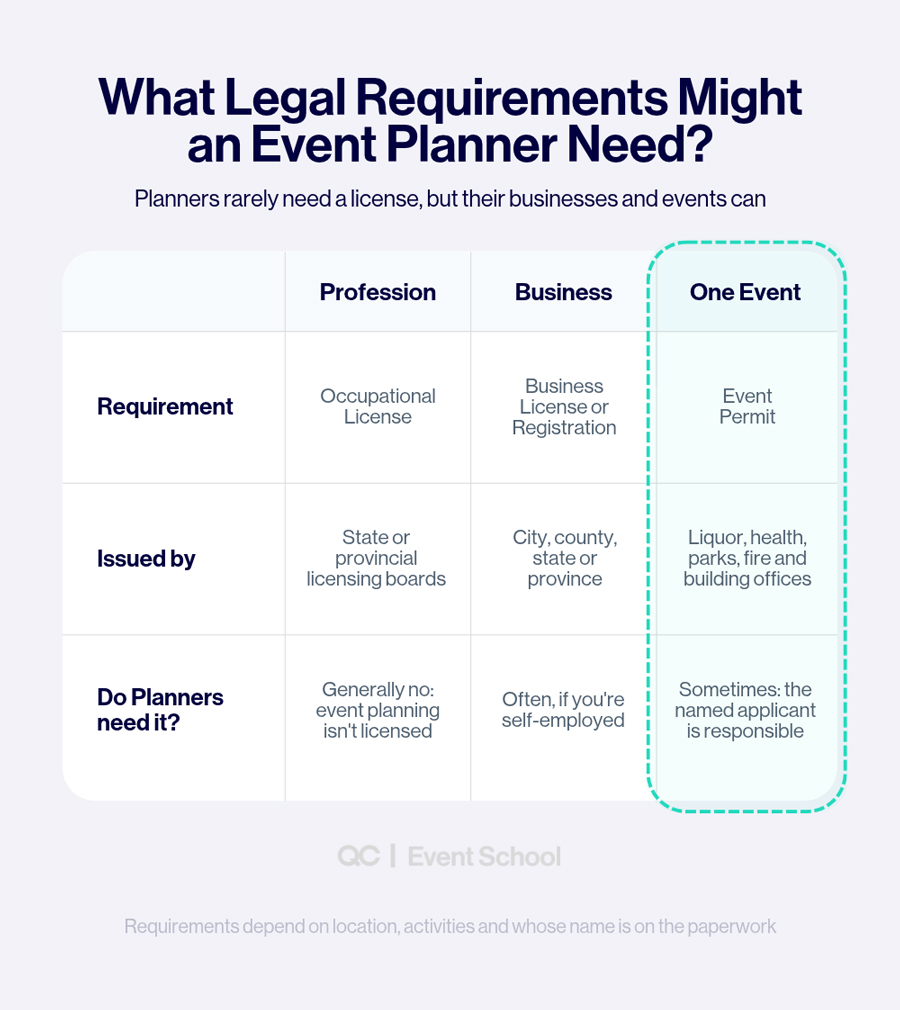
The dashed panel is the license most people search for, and it generally doesn’t exist for event planners. The two solid panels are where real obligations come from.
Takeaway: When someone says you need a license, ask which kind: the profession, the business or the event.
Do You Need a Business License to Start an Event Planning Business?
If you’re an employee of a venue, hotel or planning company, you generally don’t need a business license. Your employer’s registrations cover it.
If you take clients under your own name, the requirements become yours.
In the United States
- ●Working under your legal name? A sole proprietor may not need to register at all, though skipping it means no liability protection.
- ●Using a trade name like “Willow & Vine Events”? You’ll usually file a DBA with your state, county or city.
- ●Local business license: many cities and counties require one.
- ●Tax IDs: your state may require one. A federal EIN is required once you hire employees or operate as a corporation or partnership (SBA, 2026).
In Canada
- ●Business name: if you operate under a name other than your own, register it with your province.
- ●GST/HST: register with the Canada Revenue Agency once taxable sales pass $30,000 in a single calendar quarter or over four consecutive quarters (CRA, When to register for and start charging the GST/HST).
- ●Municipal rules: your city may require a business license, or a home occupation permit if you work from home.
Don’t forget zoning. Even a home-based business with no client visits can fall under local zoning rules. Check with your city’s planning office before listing a home address.
Takeaway: Employees rarely need a license of their own; self-employed planners usually need some combination of name registration, a local license and tax registration.
After 25 years as a restaurant owner, I’ve embarked on an exciting new career path as a Day-of Coordinator.
— Dounia Saikaley, founder of DOUNIA & CO. Event Day Coordination and QC Event & Wedding Planning graduate · Explore the Event & Wedding Planning course

What Permits Might You Need When Planning an Event?
Permits attach to activities, not professions. The same backyard wedding might need no permits, or three, depending on:
- ●Whether alcohol is sold or served
- ●Whether a tent goes up
- ●Whether a road or park is used
The examples below are common triggers, not a complete list.
Alcohol
Common misconception: planners don’t automatically need their own liquor license. (The 2022 version of this article got this wrong.)
- ●At a licensed venue or with a licensed caterer, the license usually already exists and belongs to them.
- ●In the US, alcohol sales are licensed through state and local alcohol beverage control boards (SBA, 2026).
When no licensed party is involved, someone has to apply. In Ontario, that’s a Special Occasion Permit (AGCO, Private Event SOPs):
- ●Required when alcohol is served outside a licensed establishment or a private place like a home
- ●The applicant must be 19 or older
- ●Apply at least 10 days before a private event
- ●The permit holder must be at the event and is responsible for it
Think carefully before putting your own name on a client’s permit.
Responsibility doesn’t end with the permit. Saskatchewan’s liquor regulator warns that hosts may be held liable for their guests’ actions, including guests who leave intoxicated and cause harm (SLGA Responsible Hosting Guide, 2026). Rules vary by province and state, so:
- ●Ask a lawyer or licensed broker how they apply to your events
- ●Put alcohol service terms in your contracts
Catering and Food Service
Food permits usually belong to the caterer or food truck operator, who is inspected by local public health. Your job: confirm they hold current permits for this location, especially out-of-town vendors and temporary food stalls.
Public Spaces and Street Closures
Parks, plazas and streets usually need a municipal special event or park permit, often with insurance conditions.
Example: San Francisco requires at least $2 million in general liability coverage for a city park event (SF.gov, 2026).
Tents, Noise and Fire Safety
Watch for these approvals:
- ●Large tents: building department approval
- ●Late-night amplified music: a noise exemption
- ●Fireworks or open flame: fire department sign-off
In Ontario, outdoor SOP holders must also notify the municipality, police, fire and health departments, plus the building department if a tent or tiered seating is used (AGCO).
Who Is Responsible for Getting the Permit?
Whoever is named as the applicant is responsible. That might be the venue, the caterer, the client or you.
As one experiential marketing executive advises, first identify who has the liquor license (BizBash). Then write the answer into your contracts.
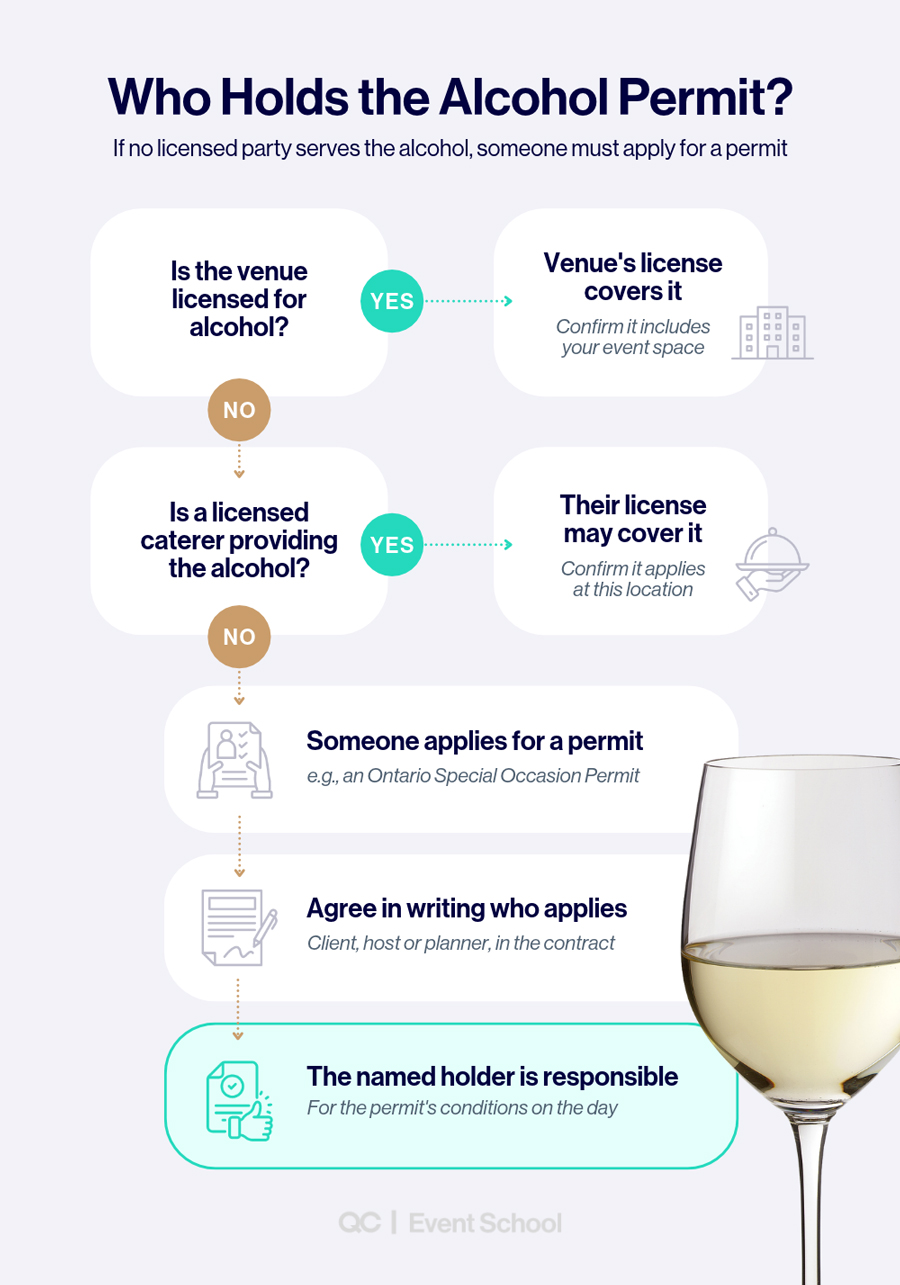
Check the two licensed parties first. A new permit is only needed when neither one covers the event, and then the contract should say who applies.
Takeaway: Never assume a permit is someone else’s job; confirm in writing who applies, whose name is on it and who will be on site.
Now I feel more confident in creating accurate timelines, budgets and assessing venues for our clients.
— Cindy Habet, party rental company co-owner and QC Event & Wedding Planning graduate · See how the course builds these skills


Photo of Event planned by Cindy Habet, QC Graduate.
Do Event Planner License Requirements Differ in the United States and Canada?
Both countries work the same way: no occupational license, with business and event rules set at several levels of government. Those rules can change from one town to the next.
United States
Requirements stack in layers, and local rules vary widely (SBA, 2026):
- Federal: only for specific regulated activities
- State: business registration and a broader range of licensed activities
- County and city: local business licenses, zoning and event permits
If you’re based in one city and run an event in another, check both.
Canada
Rules come from three levels of government:
- ●Federal: tax registration with the Canada Revenue Agency
- ●Provincial or territorial: business name registration and liquor permits (the AGCO in Ontario)
- ●Municipal: business licenses, zoning, and park and road permits
Helpful tool: BizPaL, run by Innovation, Science and Economic Development Canada, lists the permits and licenses for your business type and location (ISED, BizPaL).
| What You’re Checking | United States | Canada |
|---|---|---|
| Business registration and local licenses | SBA Launch your business, then your Secretary of State and city or county clerk | BizPaL, then your province’s business registry and municipality |
| Federal or national tax ID | IRS EIN (required with employees or for corporations and partnerships) | CRA business number; GST/HST account once sales pass $30,000 in one quarter or over four consecutive quarters |
| Alcohol at events | State and local alcohol beverage control boards (see SBA’s licensing guide) | Provincial liquor regulator (e.g., AGCO in Ontario) |
| Parks, streets, tents, fireworks | City or county special event office, building and fire departments | Municipal clerk, parks, building and fire departments |
Takeaway: Check where your business is based and where each event happens, because the two can have different rules.
📅 Want to plan events across borders? Destination events add a layer of local rules, vendors and permits. QC’s Destination Wedding Planning course covers coordinating vendors long distance and working with local partners abroad. Learn about Destination Wedding Planning
Do Event Planners Need Liability Insurance?
Usually, no law requires a solo planner to carry liability insurance. But venues and permit offices often won’t approve an event without a certificate of insurance. In practice, you’ll likely need it.
Legal requirements start when you hire. Businesses with employees must carry workers’ compensation and unemployment insurance, and some states require more (SBA, 2026).
Venue and permit requirements get specific. San Francisco’s park event permits, for example, require (SF.gov, 2026):
- ●At least $2 million in general liability coverage
- ●The city named as an additional insured
- ●The organizer’s name matching on both the insurance and the permit
If your client is the named organizer but the policy is yours, the permit can be held up.
The policies you’ll hear about most (SBA, 2026):
| Policy | What It Covers | Who Usually Buys It |
|---|---|---|
| General liability | Third-party injury and property damage | Your business |
| Professional liability | Financial loss from errors or negligence in your services | Your business |
| Event-specific (including host liquor) | A single event date | The client or event host |
A licensed insurance broker can confirm what a specific policy covers.
Takeaway: Treat insurance as a booking requirement: ask every venue and permit office for its certificate requirements before you sign, and match the names exactly.
📅 Want the full launch plan? Registration, insurance and contracts are only part of starting out. Read How to Start an Event Planning Business: A Step-by-Step Guide
How to Check Event Planner License and Permit Requirements in Your Area
Map your obligations once for your business, then again for each event. Work through these steps in order:
- Locate your business and your events. Note the city and county or municipality where you’re based, and where each event will take place.
- Check business registration and licensing. Use the SBA’s state lookup in the US or BizPaL in Canada, then confirm with your city clerk.
- List each event’s activities. Alcohol, food, amplified music, tents, fireworks, road use or park use each trigger their own permits.
- Contact the right office for each activity. That means the liquor regulator, public health, parks, building and fire departments.
- Confirm who holds what. Ask the venue and each vendor which licenses and permits they hold and which they expect you or the client to obtain.
- Document everything. Keep copies of permits, insurance certificates and the names on each, filed with the event.
Gabrielle, now in her fifth year running Weddings by Gabrielle in Salt Lake City, gives new planners this advice: “Treat it like a business from day one with clear packages, contracts, and systems.” For compliance, the contract is where step 5 gets settled. It puts in writing who obtains each permit before anyone assumes it’s someone else’s job.
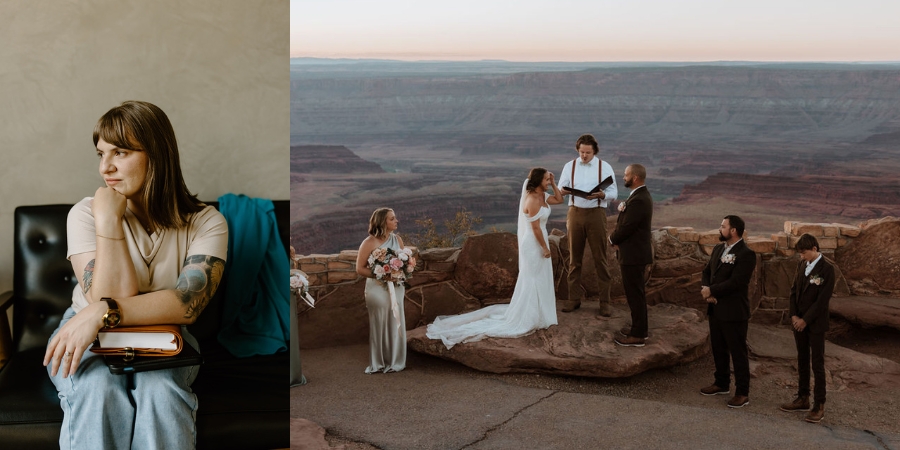
Photography by Anna Boynton Photography (headshot of Gabrielle) and Matt Davidson Photography (Canyon Ceremony)
First-Booking Compliance Checklist
- ●Business name registered (or confirmed not required)
- ●Local business license obtained (or confirmed not required)
- ●Tax registration checked (EIN, state tax ID, or CRA business number and GST/HST)
- ●Contract states who obtains each permit
- ●Venue’s liquor license or the event’s alcohol permit confirmed, with the holder named
- ●Caterer’s food permits confirmed for this location
- ●Park, street, tent, noise or fire permits identified
- ●Insurance certificate requirements received from the venue and permit offices
- ●Names on permits, insurance and contracts match
- ●Copies filed with the event folder
Download the printable First-Booking Compliance Checklist (PDF)
Takeaway: A requirement you check before signing is a line item; the same requirement discovered the week of the event is a crisis.
📅 Practice on real-world scenarios first. In QC’s Event & Wedding Planning course, assignments put you through realistic client scenarios, and working industry professionals review your work in seven one-on-one mentor reviews. It’s a lower-stakes place to learn what to ask venues and vendors before your first paid booking. Explore Event & Wedding Planning
Is Event Planning Certification the Same as a License?
No. A license is permission from a government. A certification is a credential showing training or experience. Three things often get blurred together:
- ●A course certificate shows you completed a training program, such as QC Event School’s International Event and Wedding Planning Professional (IEWP™) designation.
- ●A professional certification, such as the CMP or CSEP, is issued by an industry body, which sets its own eligibility rules.
- ●A license or permit is issued by a government and is the only one of the three that carries legal force.
No certification replaces a license or permit, and no license requires certification.
To compare training paths, read Event Planner Certification or Event Planner Degree?
Takeaway: Credentials build client trust and skills; licenses and permits keep you legal. You may want both, but they solve different problems.

Photography by @olgakaethlerphotography, shoot styled by Aynsley Neufeld.
My certification provides me that leg up and gives me confidence to charge what I am charging because I’m a valuable asset to anyone’s wedding.
— Aynsley Neufeld, founder of Weddings by Aynsley and QC Event & Wedding Planning, Luxury, Destination and Event Decor graduate · Explore the Event & Wedding Planning course

Three Common Scenarios, and Who Holds the Paperwork
These illustrative scenarios are based on the rules cited above. They aren’t accounts of specific QC students.
The Farm Wedding (Ontario)
- ●Challenge: An open bar at a private 120-guest reception on a family farm, with no licensed venue or caterer.
- ●Intervention: The couple applies for a No Sale Private Event SOP 10 days or more ahead, and names a designated family member to be on site. The planner sends the outdoor notification letters and the tent sketch.
- ●Result: The permit sits with the people hosting the party, and the planner’s role is documented in the contract.
The Company Picnic in a City Park (San Francisco)
- ●Challenge: A corporate client books a park picnic through its planner.
- ●Intervention: The planner confirms who is the named organizer, then makes sure the client’s insurer issues a $2 million general liability certificate in that same name, naming the city as additional insured.
- ●Result: The names on the permit and the insurance match, so the permit isn’t held up.
The Hotel Gala
- ●Challenge: A nonprofit’s 300-guest gala in a hotel ballroom, with an open bar and late-night music.
- ●Intervention: The planner confirms the hotel’s liquor license covers the ballroom and checks whether amplified music past the city’s quiet hours needs an exemption.
- ●Result: No new alcohol permit is needed, because the hotel’s license already applies.
Takeaway: The same planner can need no permits, one permit or several, depending on the venue and who applies.
📅 Lining up your first booking? Once your paperwork is sorted, the next step is finding clients. Read How to Get Clients as an Event Planner

Photography by @olgakaethlerphotography, shoot styled by Aynsley Neufeld.
FAQs About Event Planner Licenses
Can you plan events without a business license?
Sometimes. In some US jurisdictions, a sole proprietor working under their own legal name has few or no registration requirements, but many cities require a general business license for any business. Check your city or county before taking paid work.
Do freelance event planners need a license?
They don’t need an occupational license. They may need the same business registrations as any self-employed service provider, plus whatever permits each event requires.
Do wedding planners need a different license?
No. Wedding planning follows the same rules as other event planning. Weddings just tend to trigger alcohol, tent and outdoor-venue permits more often.
Who obtains event permits, the planner or the client?
Whoever is named as the applicant: the client, the venue, a vendor or the planner. Settle it in your contract before the event, because the named person carries the responsibility.
Can you work as an event planner without certification?
Yes, legally. Certification isn’t a legal requirement, though it can help with skills and client trust.
The Bottom Line
You don’t need a license to call yourself an event planner. You do need to know:
- ●Which business registrations apply where you live
- ●Which permits each event triggers
- ●Whose name goes on each one
Sorting it out at the contract stage is far easier than the week of the event.
Why this matters: in QC Event School’s New Student Survey, 56% of 2,324 respondents said they enrolled to start their own business. For them, this paperwork is part of the job.
Building Your Own Event Planning Business?
QC Event School’s Event & Wedding Planning course includes a full unit on launching and running an event planning business, with one-on-one feedback from working planners.
This article provides general information, not legal advice. Requirements change; confirm current rules with the agencies for your location before each event. Jurisdiction examples reflect sources checked in October 2026.
Sources
- U.S. Small Business Administration, Launch your business (licenses, permits, tax IDs, insurance), updated August 2026
- Innovation, Science and Economic Development Canada, BizPaL
- Alcohol and Gaming Commission of Ontario, Special Occasion Permits: Private Events
- Saskatchewan Liquor and Gaming Authority, Responsible Hosting Guide, 2026
- City and County of San Francisco, Insurance requirements for special event permits
- Canada Revenue Agency, When to register for and start charging the GST/HST
- BizBash, Checklist: 9 Things to Know If You’re Serving Alcohol at Events
- QC Event School New Student Survey (n=2,324), first-party data
- QC Event School graduate questionnaires: Gabrielle (Weddings by Gabrielle) and Aynsley Neufeld (Weddings by Aynsley), first-party interviews